 Add to Chrome
 Add to Firefox
 Add to Edge
Building and Road Recognition in Dense Urban Informal Settlements: A Dataset and Benchmark
May 28, 2026
As a widespread form of informal settlements, urban villages present significant challenges for sustainable urban development and governance. Precise mapping of their infrastructure is essential, however, existing remote sensing datasets primarily focus on formal urban environments, lacking fine-grained annotated data for the high-density building patterns and narrow road networks typical of urban villages. To address this gap, we introduce the \textit{DenseUIS} dataset, the first high-resolution remote sensing dataset specifically designed for building and road extraction in extremely dense urban informal settlements, covering 126 urban villages across Shenzhen and Guangzhou in China. Furthermore, we conduct a comprehensive evaluation of state-of-the-art deep learning models on this dataset. Experimental results reveal the limitations of existing methods in handling the unique morphological patterns of dense informal settlements, underscoring the need for specialized approaches. \textit{DenseUIS} therefore provides a robust benchmark for advancing fine-grained urban mapping in complex and high-density informal environments. The dataset is publicly available at https://github.com/rui-research/DenseUIS.

Towards Active Real-to-Twin Inspection: A New Paradigm for Zero-Shot Anomaly Detection
May 25, 2026The deployment of zero-shot anomaly detection (AD) in embodied industrial inspection is severely bottlenecked by its reliance on passive, fixed-viewpoint 2D imagery. Such formulations inherently fail to accommodate the active, dynamic observations required in real-world environments. To break this limitation, we introduce Real-to-Twin Anomaly Detection, a novel task that evaluates physical observations directly against geometrically matched CAD Digital Twins. To tackle this new task, we propose AVATAR, a framework designed to learn robust semantic alignment between Real and Digital Twins. By bridging benign Sim2Real domain gaps using only defect-free pairs, AVATAR effectively transforms CAD priors into dynamic, anomaly-free references. This elegant formulation enables the model to localize diverse anomalies in a zero-shot manner as unalignable deviations, eliminating the need for defect annotations. Extensive experiments demonstrate that AVATAR substantially outperforms adapted state-of-the-art baselines, exhibiting exceptional robustness to severe viewpoint variations. The code and dataset will be made publicly available.
PP-OCRv5: A Specialized 5M-Parameter Model Rivaling Billion-Parameter Vision-Language Models on OCR Tasks
Mar 25, 2026The advent of "OCR 2.0" and large-scale vision-language models (VLMs) has set new benchmarks in text recognition. However, these unified architectures often come with significant computational demands, challenges in precise text localization within complex layouts, and a propensity for textual hallucinations. Revisiting the prevailing notion that model scale is the sole path to high accuracy, this paper introduces PP-OCRv5, a meticulously optimized, lightweight OCR system with merely 5 million parameters. We demonstrate that PP-OCRv5 achieves performance competitive with many billion-parameter VLMs on standard OCR benchmarks, while offering superior localization precision and reduced hallucinations. The cornerstone of our success lies not in architectural expansion but in a data-centric investigation. We systematically dissect the role of training data by quantifying three critical dimensions: data difficulty, data accuracy, and data diversity. Our extensive experiments reveal that with a sufficient volume of high-quality, accurately labeled, and diverse data, the performance ceiling for traditional, efficient two-stage OCR pipelines is far higher than commonly assumed. This work provides compelling evidence for the viability of lightweight, specialized models in the large-model era and offers practical insights into data curation for OCR. The source code and models are publicly available at https://github.com/PaddlePaddle/PaddleOCR.
Boosting Document Parsing Efficiency and Performance with Coarse-to-Fine Visual Processing
Mar 25, 2026Document parsing is a fine-grained task where image resolution significantly impacts performance. While advanced research leveraging vision-language models benefits from high-resolution input to boost model performance, this often leads to a quadratic increase in the number of vision tokens and significantly raises computational costs. We attribute this inefficiency to substantial visual regions redundancy in document images, like background. To tackle this, we propose PaddleOCR-VL, a novel coarse-to-fine architecture that focuses on semantically relevant regions while suppressing redundant ones, thereby improving both efficiency and performance. Specifically, we introduce a lightweight Valid Region Focus Module (VRFM) which leverages localization and contextual relationship prediction capabilities to identify valid vision tokens. Subsequently, we design and train a compact yet powerful 0.9B vision-language model (PaddleOCR-VL-0.9B) to perform detailed recognition, guided by VRFM outputs to avoid direct processing of the entire large image. Extensive experiments demonstrate that PaddleOCR-VL achieves state-of-the-art performance in both page-level parsing and element-level recognition. It significantly outperforms existing solutions, exhibits strong competitiveness against top-tier VLMs, and delivers fast inference while utilizing substantially fewer vision tokens and parameters, highlighting the effectiveness of targeted coarse-to-fine parsing for accurate and efficient document understanding. The source code and models are publicly available at https://github.com/PaddlePaddle/PaddleOCR.
ERNIE 5.0 Technical Report
Feb 04, 2026In this report, we introduce ERNIE 5.0, a natively autoregressive foundation model desinged for unified multimodal understanding and generation across text, image, video, and audio. All modalities are trained from scratch under a unified next-group-of-tokens prediction objective, based on an ultra-sparse mixture-of-experts (MoE) architecture with modality-agnostic expert routing. To address practical challenges in large-scale deployment under diverse resource constraints, ERNIE 5.0 adopts a novel elastic training paradigm. Within a single pre-training run, the model learns a family of sub-models with varying depths, expert capacities, and routing sparsity, enabling flexible trade-offs among performance, model size, and inference latency in memory- or time-constrained scenarios. Moreover, we systematically address the challenges of scaling reinforcement learning to unified foundation models, thereby guaranteeing efficient and stable post-training under ultra-sparse MoE architectures and diverse multimodal settings. Extensive experiments demonstrate that ERNIE 5.0 achieves strong and balanced performance across multiple modalities. To the best of our knowledge, among publicly disclosed models, ERNIE 5.0 represents the first production-scale realization of a trillion-parameter unified autoregressive model that supports both multimodal understanding and generation. To facilitate further research, we present detailed visualizations of modality-agnostic expert routing in the unified model, alongside comprehensive empirical analysis of elastic training, aiming to offer profound insights to the community.
PaddleOCR-VL-1.5: Towards a Multi-Task 0.9B VLM for Robust In-the-Wild Document Parsing
Jan 29, 2026We introduce PaddleOCR-VL-1.5, an upgraded model achieving a new state-of-the-art (SOTA) accuracy of 94.5% on OmniDocBench v1.5. To rigorously evaluate robustness against real-world physical distortions, including scanning, skew, warping, screen-photography, and illumination, we propose the Real5-OmniDocBench benchmark. Experimental results demonstrate that this enhanced model attains SOTA performance on the newly curated benchmark. Furthermore, we extend the model's capabilities by incorporating seal recognition and text spotting tasks, while remaining a 0.9B ultra-compact VLM with high efficiency. Code: https://github.com/PaddlePaddle/PaddleOCR
FunCineForge: A Unified Dataset Toolkit and Model for Zero-Shot Movie Dubbing in Diverse Cinematic Scenes
Jan 21, 2026Movie dubbing is the task of synthesizing speech from scripts conditioned on video scenes, requiring accurate lip sync, faithful timbre transfer, and proper modeling of character identity and emotion. However, existing methods face two major limitations: (1) high-quality multimodal dubbing datasets are limited in scale, suffer from high word error rates, contain sparse annotations, rely on costly manual labeling, and are restricted to monologue scenes, all of which hinder effective model training; (2) existing dubbing models rely solely on the lip region to learn audio-visual alignment, which limits their applicability to complex live-action cinematic scenes, and exhibit suboptimal performance in lip sync, speech quality, and emotional expressiveness. To address these issues, we propose FunCineForge, which comprises an end-to-end production pipeline for large-scale dubbing datasets and an MLLM-based dubbing model designed for diverse cinematic scenes. Using the pipeline, we construct the first Chinese television dubbing dataset with rich annotations, and demonstrate the high quality of these data. Experiments across monologue, narration, dialogue, and multi-speaker scenes show that our dubbing model consistently outperforms SOTA methods in audio quality, lip sync, timbre transfer, and instruction following. Code and demos are available at https://anonymous.4open.science/w/FunCineForge.
PaddleOCR-VL: Boosting Multilingual Document Parsing via a 0.9B Ultra-Compact Vision-Language Model
Oct 16, 2025In this report, we propose PaddleOCR-VL, a SOTA and resource-efficient model tailored for document parsing. Its core component is PaddleOCR-VL-0.9B, a compact yet powerful vision-language model (VLM) that integrates a NaViT-style dynamic resolution visual encoder with the ERNIE-4.5-0.3B language model to enable accurate element recognition. This innovative model efficiently supports 109 languages and excels in recognizing complex elements (e.g., text, tables, formulas, and charts), while maintaining minimal resource consumption. Through comprehensive evaluations on widely used public benchmarks and in-house benchmarks, PaddleOCR-VL achieves SOTA performance in both page-level document parsing and element-level recognition. It significantly outperforms existing solutions, exhibits strong competitiveness against top-tier VLMs, and delivers fast inference speeds. These strengths make it highly suitable for practical deployment in real-world scenarios.
UDDETTS: Unifying Discrete and Dimensional Emotions for Controllable Emotional Text-to-Speech
May 15, 2025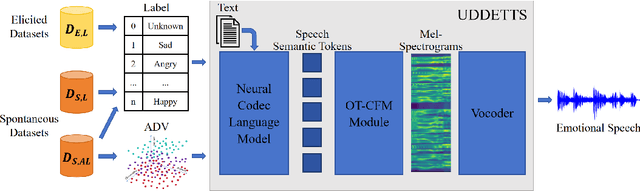

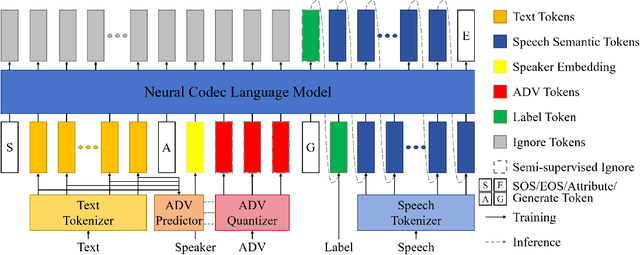
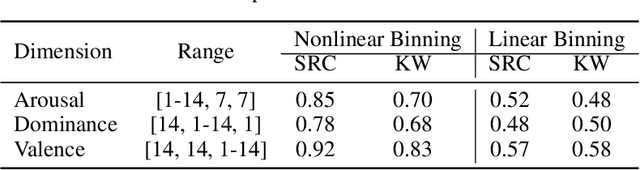
Recent neural codec language models have made great progress in the field of text-to-speech (TTS), but controllable emotional TTS still faces many challenges. Traditional methods rely on predefined discrete emotion labels to control emotion categories and intensities, which can't capture the complexity and continuity of human emotional perception and expression. The lack of large-scale emotional speech datasets with balanced emotion distributions and fine-grained emotion annotations often causes overfitting in synthesis models and impedes effective emotion control. To address these issues, we propose UDDETTS, a neural codec language model unifying discrete and dimensional emotions for controllable emotional TTS. This model introduces the interpretable Arousal-Dominance-Valence (ADV) space for dimensional emotion description and supports emotion control driven by either discrete emotion labels or nonlinearly quantified ADV values. Furthermore, a semi-supervised training strategy is designed to comprehensively utilize diverse speech datasets with different types of emotion annotations to train the UDDETTS. Experiments show that UDDETTS achieves linear emotion control along the three dimensions of ADV space, and exhibits superior end-to-end emotional speech synthesis capabilities.
DiffStyleTTS: Diffusion-based Hierarchical Prosody Modeling for Text-to-Speech with Diverse and Controllable Styles
Dec 04, 2024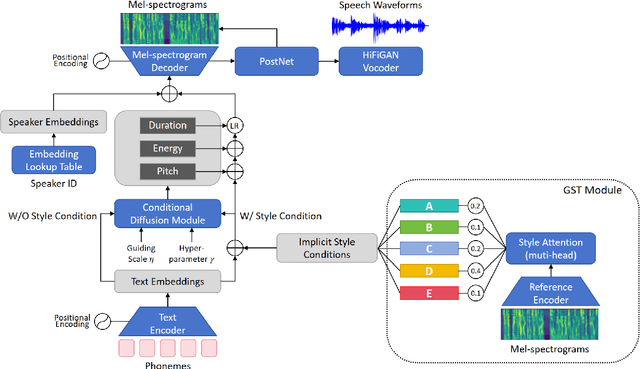
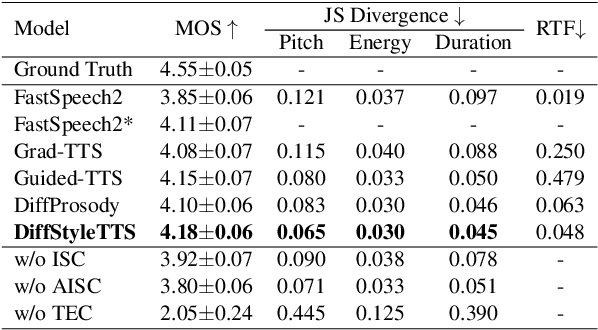
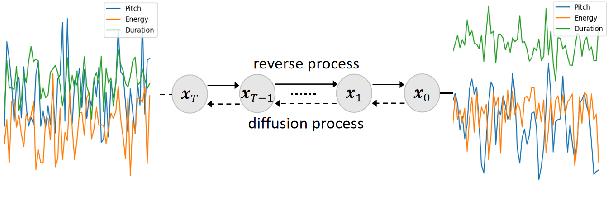
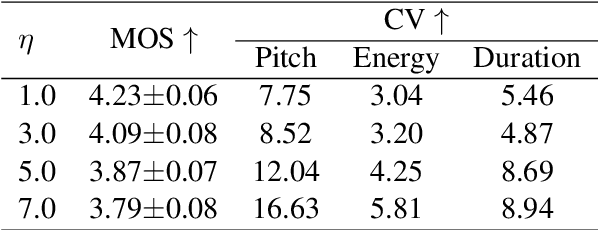
Human speech exhibits rich and flexible prosodic variations. To address the one-to-many mapping problem from text to prosody in a reasonable and flexible manner, we propose DiffStyleTTS, a multi-speaker acoustic model based on a conditional diffusion module and an improved classifier-free guidance, which hierarchically models speech prosodic features, and controls different prosodic styles to guide prosody prediction. Experiments show that our method outperforms all baselines in naturalness and achieves superior synthesis speed compared to three diffusion-based baselines. Additionally, by adjusting the guiding scale, DiffStyleTTS effectively controls the guidance intensity of the synthetic prosody.